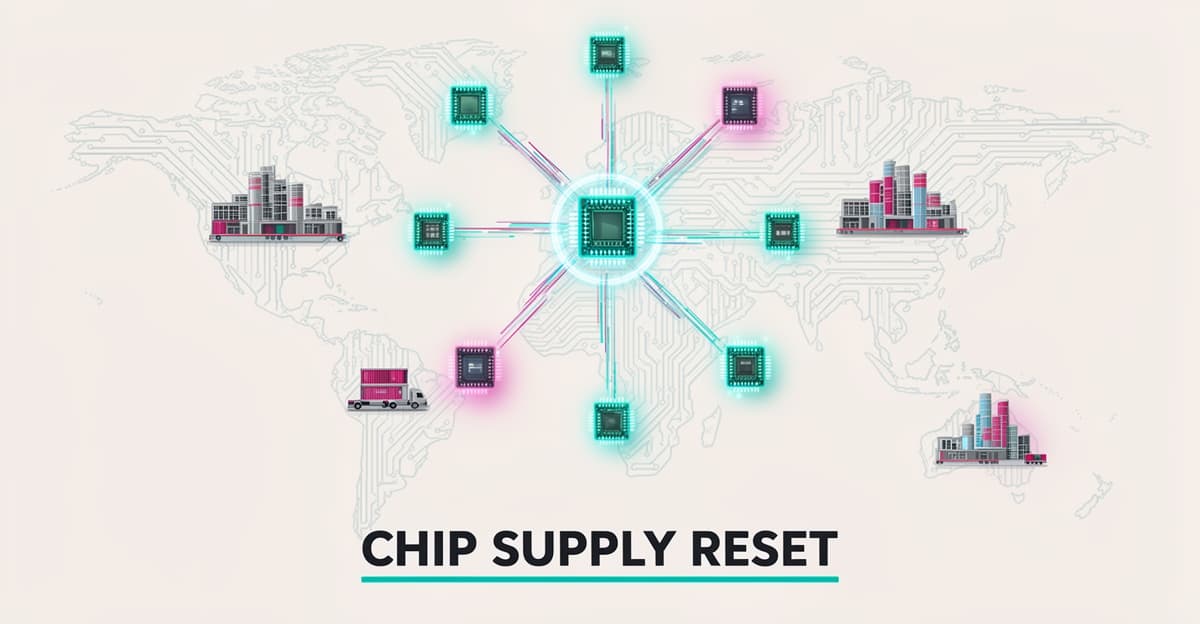
{"slug":"global-chip-supply-chains-restructuring-2026","tldr":"Fortune 500 technology firms are accelerating a shift away from concentrated semiconductor manufacturing hubs, triggering new investments, labor negotiations, and market uncertainty as geopolitical pressures reshape the global supply chain.","intro":"The global technology supply chain is undergoing its most significant realignment in a generation. Over the past week, a wave of announcements from Fortune 500 technology firms and semiconductor manufacturers has signaled a decisive break from the concentrated manufacturing models that defined the industry for decades. Driven by escalating geopolitical tensions, new trade regulations in Southeast Asia, and a sustained push for technological sovereignty, the shift is reshaping where the world's most critical components are made, who builds them, and how much they cost.","title":"Global Chip Supply Chains Enter a Period of Profound Restructuring","excerpt":"A wave of announcements from technology giants and chipmakers signals a decisive break from concentrated manufacturing, with new investments, labor negotiations, and market uncertainty reshaping the global supply chain.","sections":[{"content":"The developments came in rapid succession. On September 20, initial reports surfaced describing a major strategic pivot among leading technology firms, as rising geopolitical tensions and fresh trade regulations in Southeast Asia forced a reexamination of long-held sourcing strategies. Two days later, several semiconductor manufacturers formally announced plans to diversify production away from single-source dependencies, citing increased tariffs and persistent logistics bottlenecks as primary motivators.\n\nBy September 24, a leading industry analyst firm had published a forecast projecting a 15% rise in capital expenditure on domestic chip fabrication facilities in the United States and European Union over the next 18 months. The following day, labor unions in key manufacturing hubs began negotiating wage adjustments, responding to the wave of automation investments accompanying reshoring initiatives. As of today, investors are actively assessing what these structural changes mean for profitability, margins, and innovation pipelines across the technology sector.","headline":"A Week That Redrew the Map"},{"content":"This week's headlines did not emerge in a vacuum. They represent the latest chapter in a multi-year trend toward supply chain resilience, one that began accelerating with the disruptions of the early 2020s and intensified dramatically amid ongoing technological competition between the United States and China. Since 2023, successive waves of export controls on advanced computing chips have pushed multinational corporations to reconsider their reliance on a small number of geographically concentrated manufacturing hubs.\n\nAt the same time, governments have staked out ambitious positions on technological sovereignty. The U.S. CHIPS and Science Act, the EU Chips Act, and comparable initiatives in Japan and South Korea have created a fiercely competitive landscape for new fabrication plant construction, with subsidies covering as much as 50% of capital costs in certain cases. These dynamics are playing out against a backdrop of persistent inflation, shifting consumer demand, and surging requirements for specialized, high-performance chips driven by rapid advances in artificial intelligence.","headline":"The Roots of a Multi-Year Transformation"},{"content":"For companies in technology, manufacturing, and electronics-dependent sectors such as automotive, defense, and telecommunications, the implications are both operational and strategic. Reshoring and near-shoring are likely to raise short-term capital and labor costs, but they promise reduced long-term exposure to disruption and inventory volatility, a trade-off many executives now view as essential rather than optional.\n\nProximity to research centers and talent pools in reshoring regions may also accelerate product development cycles, particularly for AI and high-performance computing applications. At the same time, evolving export control regimes demand robust compliance frameworks that could influence everything from product design to market access strategies. Perhaps most consequentially, firms that navigate the transition well stand to gain durable competitive advantages in reliability, speed-to-market, and eligibility for government contracts tied to domestic production requirements. The broader design philosophy of the supply chain itself is changing, with companies abandoning monolithic, geographically concentrated models in favor of modular, multi-sourced architectures.","headline":"What the Shift Means for Business"},{"content":"No restructuring of this magnitude proceeds without human consequences. The labor negotiations that began on September 25 in key manufacturing hubs reflect a growing recognition that automation investments accompanying reshoring will fundamentally alter the nature of manufacturing work. Unions are pressing for wage adjustments that acknowledge the higher skill requirements of new fabrication facilities, while workers and employers alike grapple with the pace of change.\n\nRetraining programs are becoming a central feature of the reshoring story, particularly in regions such as Ohio, Arizona, and parts of Germany where new facilities are taking root. The outcome of these negotiations could shape not only labor costs but also the speed at which new plants reach full production capacity.","headline":"The Workforce Question"},{"content":"Investor reaction to the week's developments remains a work in progress. Financial markets have been closely tracking the stock performance of affected companies, with analysts weighing near-term margin pressures against the potential for long-term stability and growth. The cost implications of building new fabrication capacity are substantial, and questions persist about whether current levels of public subsidy can be sustained.\n\nThere is also a broader debate underway about whether reshoring will foster genuine innovation or simply replicate existing production models in new locations. Academics and industry research leaders are divided, though most agree that the convergence of policy support, AI-driven chip demand, and geopolitical necessity makes this realignment different from previous cycles of manufacturing repatriation.","headline":"Markets Watch and Wait"}],"conclusion":"The events of the past week mark a turning point in how the global technology industry approaches its most critical supply chains. With capital flowing into new fabrication facilities, governments competing through subsidy programs, labor unions asserting their stake, and investors weighing the risks and rewards, the restructuring now underway will take years to fully play out. What is already clear is that the era of concentrated, single-source semiconductor manufacturing is drawing to a close, replaced by a more distributed, resilient, and politically influenced model. For businesses and investors alike, the companies that adapt fastest to this new landscape will be the ones that define the next decade of technological progress.","key_points":["Semiconductor manufacturers announced plans in late September 2026 to diversify production away from single-source dependencies amid rising tariffs and logistics bottlenecks.","Industry analysts forecast a 15% increase in capital expenditure on U.S. and EU chip fabrication facilities over the next 18 months.","Labor unions in key manufacturing hubs have opened wage negotiations in response to automation investments tied to reshoring.","Government subsidy programs in the U.S., EU, Japan, and South Korea are covering up to half of capital costs for new fabrication plants.","Companies navigating the transition successfully could gain advantages in reliability, speed-to-market, and eligibility for government contracts."],"meta_title":"Global Chip Supply Chain Realignment: What the 2026 Shift Means for Business","meta_description":"Semiconductor makers are diversifying production as geopolitical tensions and subsidies reshape global supply chains. Here's what the 2026 realignment means for costs, labor, and innovation."}